If your Persian cat hates grooming, you are not alone, and it is not a sign you have failed. A long coat needs regular care, and some cats simply learned early on that the comb means a struggle. The good news is that grooming tolerance can often be rebuilt. This guide walks you through a calm reset: how to read the warning signs, how to restart with very short sessions, and when to hand the job to a groomer or your vet.
This article is general information, not veterinary advice.
Why a Persian cat hates grooming
Persians need more coat care than most cats. The Cat Fanciers’ Association breed profile describes a steel comb with coarse and fine teeth as essential for keeping the coat free of mats and tangles. That means your cat is handled a lot, and if those early sessions were long, rushed or painful, the comb can quickly become something to avoid.
A few common patterns show up again and again:
- Tangles that pull. Combing straight into a knot hurts. One bad experience can make a cat wary of the next session.
- Sessions that run too long. Owners often try to “catch up” on a neglected coat in one go. The cat learns that grooming never ends.
- Too much restraint. Holding a cat firmly may feel safer for you, but it can make the whole experience feel like a fight.
- Sore spots. Mats close to the skin, a tender belly or stiff joints may make certain areas uncomfortable to touch. If she suddenly objects to an area she used to tolerate, ask your vet to check her over.
That last point matters. Cats Protection notes that a change in your cat’s grooming habits could be a sign that there is a problem. A cat who used to sit happily and now growls deserves a health check before a training plan.
Learn the signs she has had enough
Stopping before your cat gets upset is the single most useful habit you can build. Cats Protection’s guide to telling if your cat is stressed lists signs such as flattened ears, wide pupils and whiskers pointed forward or curving down. A twitching tail or a sudden turn of the head toward the comb is also worth noticing.
When you see those signs, stop. Offer a treat, put the comb down and walk away calmly. If she’s had enough, stop — you can finish tomorrow. Ending on a calm note teaches her that grooming has a clear, predictable end.
The reset: rebuilding trust step by step
When a Persian cat hates grooming, think of this as starting again from the beginning, even with an adult cat. Cats Protection advises not trying to do it all at once and instead doing a little bit at a time and building it up, with as little restraint as possible. Little and often beats a big session.
Step 1: Make the comb boring
Leave the comb near her favourite resting spot for a few days. Let her sniff it. Pair its appearance with something she likes, such as a small treat or a play session, without using it at all.
Step 2: Touch without combing
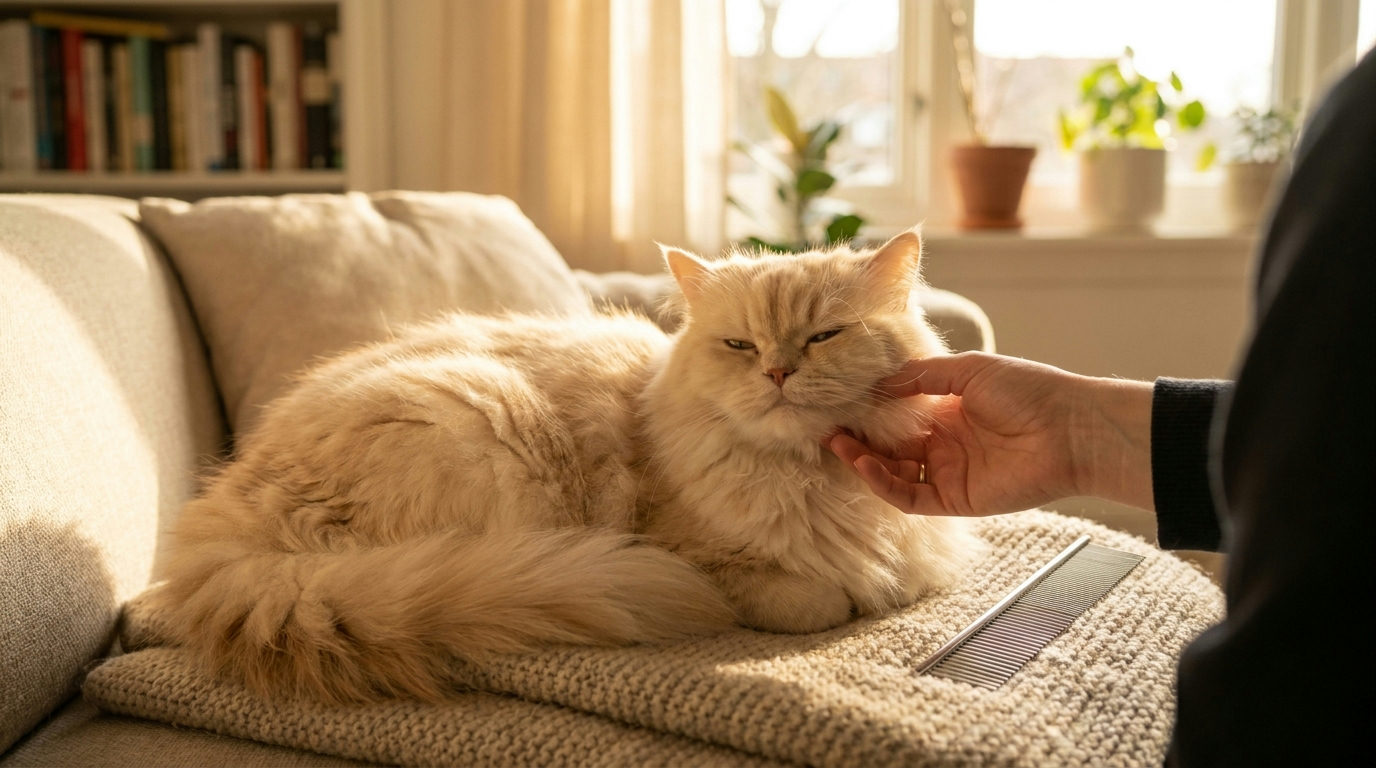
While she is relaxed on your lap or beside you, stroke her with your hand along the areas she enjoys — usually the cheeks, chin and back. Then rest the back of the comb against her for a second and reward. Repeat a few times, then stop.
Step 3: A few strokes in easy areas
Once she accepts the comb’s touch, try two or three gentle strokes on the back or shoulders, where the coat is usually easiest to manage. The ASPCA’s cat grooming tips recommend rewarding small steps quickly with a treat, which is a useful rule for any part of the routine.
Step 4: Build up slowly to harder zones
The belly, armpits, back legs and rear are common tangle spots on a long coat, and many cats are more sensitive there. Add these one at a time, over days rather than minutes. If one area triggers a reaction, go back a step for that spot only and keep working on the easier areas.
Step 5: Keep the same time and place
Cats Protection suggests brushing at around the same time each day and choosing moments when your cat is calm. A quiet evening spot after she has settled often works better than right after a meal or a burst of play.
Practical tips that make sessions easier
- Work in short blocks. One or two minutes is a successful session in the early weeks.
- Hold the hair above a tangle. Supporting the coat near the skin while you comb the ends may reduce pulling.
- Try a different tool. Cats Protection suggests experimenting with combs, brushes or grooming gloves to find what your cat tolerates best. Some cats who dislike a comb will accept a stroking mitt first.
- Use the session as a health check. Grooming is a good moment to look for fleas, lumps or sore skin. Anything unusual is a call to your vet.
- Tidy up afterwards. Loose hair left on bedding can tangle back into the coat, so a quick vacuum helps.
What not to do with mats
Mats are often the reason grooming became a battle in the first place, so this part deserves care. Cats Protection advises against trying to brush out severe mats at home because of the risk of tearing the skin. Never cut into a mat with scissors when you cannot see the skin underneath — it is very easy to nick the skin by accident.
For heavy matting, Cats Protection notes that a vet can perform a de-mat clip with the cat sedated. That route may help reset the coat so you can start your home routine from a clean slate rather than fighting old tangles. You can read more about day-to-day coat care in our grooming guides.
When to get professional help
If your Persian cat hates grooming so much that sessions turn into a fight, there is no prize for doing everything yourself. The ASPCA advises booking a professional groomer or a veterinarian if your cat fights grooming and there is a chance that either of you could be hurt. That is good advice to take seriously.
Call your vet if:
- Your cat suddenly objects to being touched in a particular area.
- You find sores, scabs, bald patches or skin that looks red or broken.
- She has stopped grooming herself, or is grooming one area far more than usual.
- Mats are close to the skin across large areas of the body.
- Grooming triggers breathing difficulty, panting or panic. Flat-faced cats may find breathing harder when stressed, so stop and seek advice.
If the problem is fear rather than a health issue, Cats Protection notes that a qualified behaviourist can help through desensitisation training. Your vet can usually refer you. For more on reading your cat’s moods, browse our cat behavior articles.
A simple weekly routine to start with
If your Persian cat hates grooming, use this checklist for the first few weeks of the reset:
- Pick one daily time when your cat is usually calm.
- Keep each session to a few minutes and end before she shows stress signs.
- Start with easy areas and reward every small step.
- Add one tricky zone at a time, only when the easy areas are relaxed.
- Check the coat for knots, fleas and sore skin as you go.
- Leave large or tight mats to a groomer or your vet.
- Write down what worked so you can repeat it tomorrow.
The takeaway
A Persian who dreads the comb did not get that way overnight, and she will not change overnight either. Short, predictable sessions with little restraint, plenty of rewards and a clear ending may help her learn that grooming is safe again. Watch her body language, rule out pain with your vet, and get professional help for mats or any session that feels unsafe. Most owners find that the goal is not a perfect coat on day one — it is the moment you notice she tolerates it now.
This article is general information, not veterinary advice. Always ask your vet about any health concern, change in behaviour or skin problem.