Himalayan cat grooming is best understood by comparing the actual coat and the individual cat, rather than assuming a completely different routine from a Persian’s. The Cat Fanciers’ Association’s Persian information includes a Himalayan division. That classification provides context; it does not give an owner a personalized grooming schedule or predict every cat’s behavior.
This guide explains the shared care questions and the differences worth investigating in your own cat. It is general education, not medical or veterinary advice. Ask your veterinarian about health concerns and a suitable home-care plan, and ask a competent cat groomer for a demonstration where needed. No fixed bathing, clipping or nail-trimming interval is prescribed here.
Compare coat needs before comparing names
Look at the coat length, current condition and areas you can comfortably inspect under an appropriate care plan. Record where hair is catching, where the cat dislikes handling and which tasks you already complete easily. A breed name alone cannot tell you how much work a particular coat needs today.
If you previously cared for a Persian, do not assume every tool or session length transfers unchanged. Check the new cat’s response and seek professional guidance for unfamiliar areas. Likewise, do not assume the Himalayan needs a more elaborate routine because its color pattern is different. Use the observed coat and the agreed plan to decide the practical work.
Start with long-coat maintenance
Cats Protection’s grooming guidance explains that long-coated cats need regular help and recommends introducing grooming gradually. Discuss the routine with your groomer or veterinarian and fit it to the individual cat. A timetable should support manageable care, not become a demand to finish every area despite resistance or discomfort.
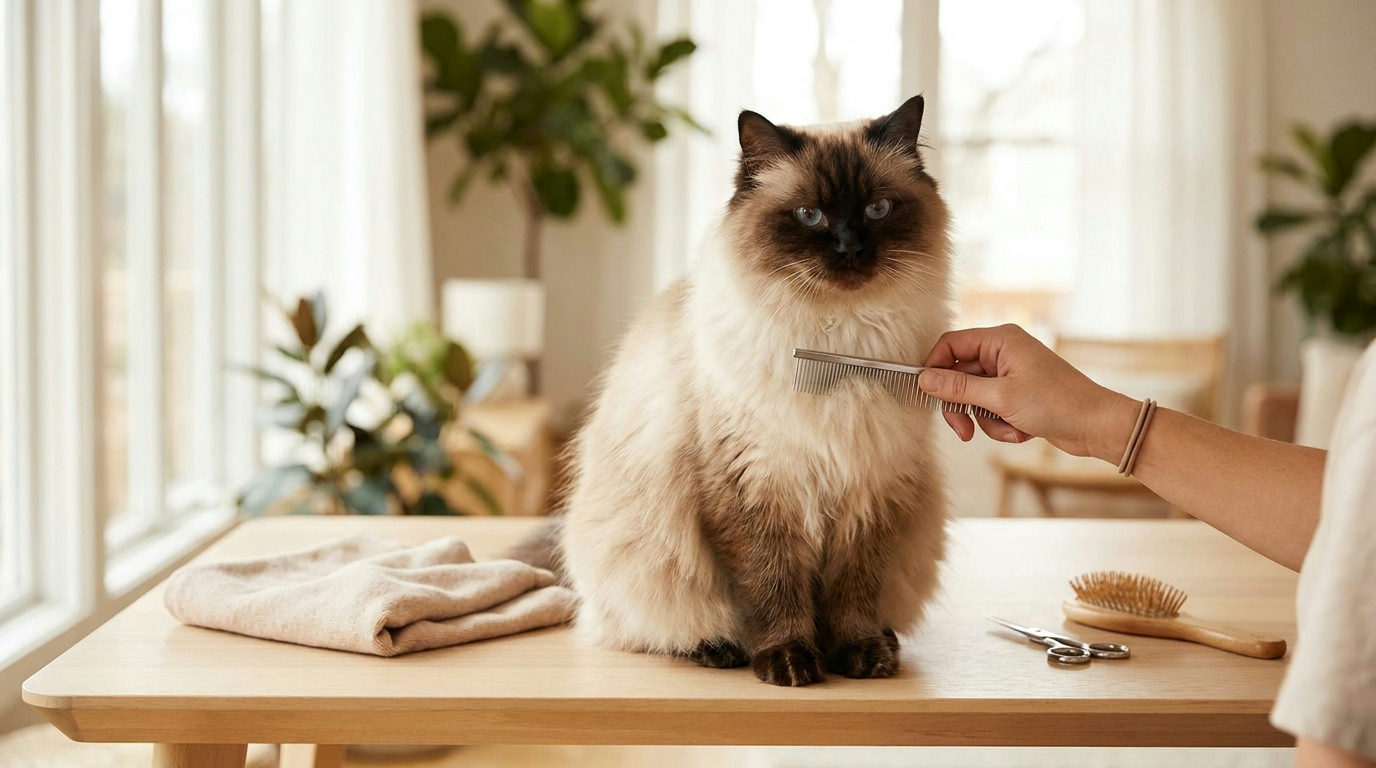
Prepare the tool and area before beginning. Choose a small accessible section permitted by the plan and use the method a professional has demonstrated. Keep the handling light and stop if the cat is uncomfortable. Do not pull through resistance merely because a comb should reach a particular depth or because a breed guide describes daily care.
Choose tools for the task and tolerance
Ask which brush or comb suits the coat and how to use it without scraping or pulling. Inspect the actual tool for rough or damaged parts. A wide-toothed and finer comb may serve different jobs, but owning both does not mean you should force one through a resistant area. Get a demonstration when uncertain.
Keep clipping tools and scissors out of an ordinary home combing plan unless an appropriately qualified professional has assessed and instructed the task. This guide does not teach a home haircut or mat-removal technique. A small set of tools you understand is more useful than a large collection whose purposes or limits are unclear.
Treat mats as a professional question
If hair is matted and cannot be easily managed, ask your groomer or veterinarian to assess it. The ASPCA’s matting guidance warns against cutting mats out with scissors and directs owners toward professional help. Do not make the cat tolerate repeated pulling while deciding whether the knot will eventually loosen.
Describe the location and any discomfort without diagnosing the skin underneath. Ask which setting and approach are appropriate for the individual cat. If veterinary assessment is recommended, make that part of the plan before cosmetic work continues. The important distinction is the condition of the coat, not whether the papers call the cat Himalayan or Persian.
Keep color and cosmetic goals separate from comfort
A pointed color pattern may draw attention to the face and extremities, but visual appearance should not dictate stronger cleaning or a particular haircut. This article does not claim that clipping will predictably change coat color or that a lighter-looking area needs a fixed washing frequency. Ask the professional what can reasonably be expected for your cat.
If you are considering a cosmetic trim, discuss the purpose, coat condition and handling limits first. Do not request a show-style result from an uncomfortable or matted cat simply because a photograph looks appealing. An agreed practical care outcome is more useful than an unsupported promise about regrowth, color or a permanently tangle-free coat.
Discuss face care individually
Ask your veterinarian or groomer which cleaning is appropriate, which products to use and when an observation needs veterinary attention. Do not assume every Himalayan needs the same number of wipes per day or that visible staining is only cosmetic. A change in the eyes, skin or discharge should be discussed rather than scrubbed away more vigorously.
Keep the face unobstructed during any permitted task and stop if the cat resists. Record instructions so household members do not add whitening products or improvised solutions. This guide does not diagnose eye discharge or prescribe a treatment. Face care should remain within the individual plan, not a blanket routine inferred from a color pattern.
Do not infer temperament from the comparison
A cat may be playful, reluctant or comfortable with one task and uncomfortable with another. Do not assume a Himalayan will be livelier than a Persian or that Persian ancestry guarantees tolerance. Observe this cat’s response and adjust the ordinary setup with appropriate professional input.
A gradual introduction can begin with simply seeing a tool and brief permitted handling, without attempting a full groom. Keep the task small enough to stop comfortably. If routine care repeatedly cannot be completed, seek help from your veterinary team or a qualified behavior professional rather than interpreting resistance as a breed trait that requires firmer restraint.
Set separate plans for paws, ears and teeth
These tasks should not be added automatically to every coat session. Ask the veterinary team whether a particular check or care step is needed and how to do it appropriately. Do not adopt a universal claw-trim interval or push items into the ear canal based on a general breed article.
Write the approved task, tool and stopping point separately for each area. If you are uncertain, request a demonstration or professional appointment. Grooming can provide an opportunity to notice a change, but it is not a diagnosis. Keep observations clear and consult the veterinarian about new concerns rather than changing products or procedures on your own.
Ask whether bathing is necessary and suitable
Discuss the reason for a proposed bath, the cat’s health and tolerance, and the appropriate setting. A pale coat does not establish that more frequent bathing is required. This guide does not prescribe a universal bath or dryer setting. Obtain instructions for your individual cat before attempting a task beyond routine comfortable coat care.
If a professional appointment is needed, ask which services are included, what happens if the cat is uncomfortable and when you will be contacted about a change. Share veterinary instructions and relevant history. Do not let a standard package replace assessment of what is appropriate for the actual coat and cat.
Keep a short comparison record
Record the tasks that work, areas needing help and instructions given by professionals. If you are comparing the routine with care of a previous Persian, write the observed differences rather than broad claims about the breeds. One cat’s comfortable session does not establish what another will tolerate.
Himalayan cat grooming shares the practical questions of long-coat Persian care while still needing an individual plan. Compare condition, tools, comfort and professional advice. Keep unsupported color, temperament and schedule assumptions out of the routine. The result should be manageable care and a clear route to help, rather than a promise that a breed-based checklist can settle every question.