
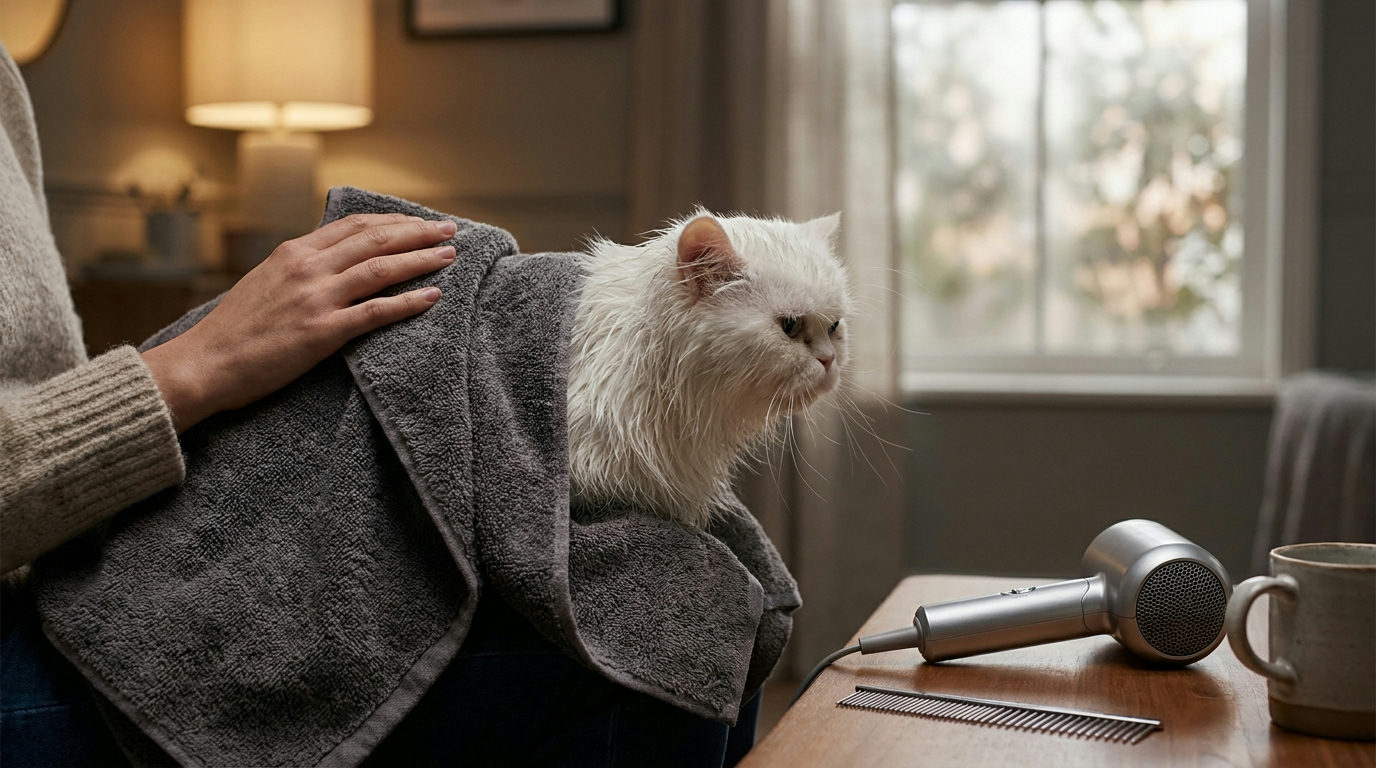
Most bathing guides spend pages on shampoo and rinsing, then say “dry thoroughly” in one line. For a Persian, drying is the hard part. That dense undercoat holds water like a sponge, and a coat left damp can mat, feel cold, and even irritate the skin. Knowing how to dry a Persian cat properly makes the whole bath worth doing.
This guide covers towel drying, using a dryer safely, the flat-face precautions many owners miss, and what to do if your cat will not tolerate a dryer at all.
Not veterinary advice: This content is not a substitute for professional veterinary advice, diagnosis or treatment. Always consult your veterinarian about your own cat.
Why drying matters so much for Persians
A Persian’s coat has two layers: long outer guard hairs and a thick, soft undercoat close to the skin. The undercoat traps water, and if it dries slowly on its own, several things can go wrong:
- Mats form as it dries. Damp undercoat clumps together, and those clumps set into mats.
- Your cat gets cold. A soaked coat pulls heat from the body, and a chilled cat is an unhappy cat.
- The skin stays damp. Skin that stays wet under a thick coat for hours may become irritated.
- Your cat keeps grooming. A damp cat licks for longer, which means swallowing more hair.
So the goal is not just “dry to the touch” on the surface. It is dry right down to the skin.
Before the bath: set up your drying station
Getting everything ready first means you are not hunting for towels with a dripping cat in your arms.
- Three or four thick, absorbent towels, or microfibre pet towels.
- A warm, draught-free room with the door closed.
- A pet dryer or a human hairdryer with a cool or low-heat setting and a low-speed option.
- A wide-toothed metal comb and a finer comb.
- Treats.
- A non-slip mat or towel on a table or your lap.
Our guide to bathing a Persian covers the wash itself. Here we pick up the moment the rinse is done. Some pages on this site contain affiliate links; this article does not.
Step 1: squeeze, don’t rub
While your cat is still in the sink or tub, gently squeeze water out of the coat with your hands, working from the neck down to the tail and down each leg. Do not wring or twist the fur.
Then wrap your cat in a towel and press, rather than rub. Rubbing a long, wet coat back and forth is a quick way to create tangles. Press the towel into the coat, lift, and move to the next area. Swap to a dry towel as soon as the first one is soaked. With a big Persian coat, you may go through three or four.
Step 2: decide whether to use a dryer
Towels alone rarely dry a Persian’s undercoat. Many owners use a dryer to finish the job, and many cats accept it with patience. But a dryer is optional. If your cat panics at the noise, skip to the “no-dryer” method below.
Step 3: how to dry a Persian cat with a dryer safely
This is where care matters most.
Keep the heat low
Use a cool or lowest-warm setting. Hot air can burn skin, and cats cannot always move away from it. Hold your hand in the airflow regularly. If it feels hot on your skin, it is too hot for your cat.
Keep the speed low
A strong blast of air is frightening and can tangle the coat. Start on the lowest speed. Some cats accept a slightly stronger flow once they are used to it.
Keep air away from the face
Persians are flat-faced, and cats.com’s heatstroke guide notes that flat-faced cats often cannot breathe as efficiently as other cats. A stream of air blowing into a flat face is uncomfortable and can make breathing harder. Dry the head and face with towels only, and direct the dryer at the body and legs.
Never use a closed drying box at home
Enclosed drying cabinets or cage dryers can overheat a cat quickly. PDSA lists brachycephalic cats such as Persians among those most at risk of heatstroke. Stay with your cat the whole time and dry by hand.
Comb as you dry
Hold the dryer in one hand and a wide-toothed comb in the other. Lift a section of fur, blow the air into the base of the coat along the direction of growth, and comb gently as it dries. Work in small sections across the body. Drying and combing together separates the undercoat and stops mats setting.
Take breaks
Drying a full Persian coat can take twenty to forty minutes. International Cat Care’s grooming advice recommends keeping sessions short and stopping if your cat is not enjoying it. Pause every few minutes, offer a treat, and let your cat settle.
The no-dryer method
If your cat will not tolerate a dryer, you can still get the coat dry, it just takes longer:
- Towel-dry thoroughly, using several fresh towels.
- Put your cat in a warm, closed room with no draughts, with a dry towel or bed to lie on.
- Every fifteen to twenty minutes, gently comb through a few sections to stop the undercoat clumping.
- Swap the towel underneath for a dry one when it gets damp.
- Keep your cat inside until they are completely dry, which may take several hours.
Some owners find it easier to have a professional groomer handle baths for cats who hate dryers. Our guide to choosing a professional groomer covers what to ask.
How to check the coat is fully dry
Surface dryness can fool you. To check properly:
- Part the fur in several places, especially the chest, armpits, belly and back legs, and touch the skin. It should feel dry, not cool and damp.
- Run a fine comb through to the skin. It should glide through without sticking.
- Look for areas that look darker or flatter than the rest. These are often still damp.
Getting your cat used to the dryer
If you plan to bathe your Persian regularly, dryer training pays off:
- Leave the dryer out, switched off, near where your cat eats or plays.
- Switch it on low in another room, then gradually closer, with treats each time.
- Let a gentle stream of cool air touch your cat’s back for a second, then treat.
- Build up over several short sessions before you ever use it after a bath.
Drying checklist
- Set up towels, dryer, combs and treats before the bath.
- Squeeze and press water out; never rub.
- Use low heat and low speed, and test the airflow on your hand.
- Keep the dryer away from the face; towel-dry the head.
- Comb in sections as you dry.
- Never use a closed drying box; stay with your cat.
- Check the skin, not just the surface, before you finish.
Learning to dry a Persian cat well turns bath day from a battle into a routine. Go slowly, keep the air gentle, and finish with a coat that is dry to the skin and free of tangles.
Not veterinary advice: this article is general guidance and is not a substitute for professional veterinary advice. Consult your veterinarian about your own cat.

