
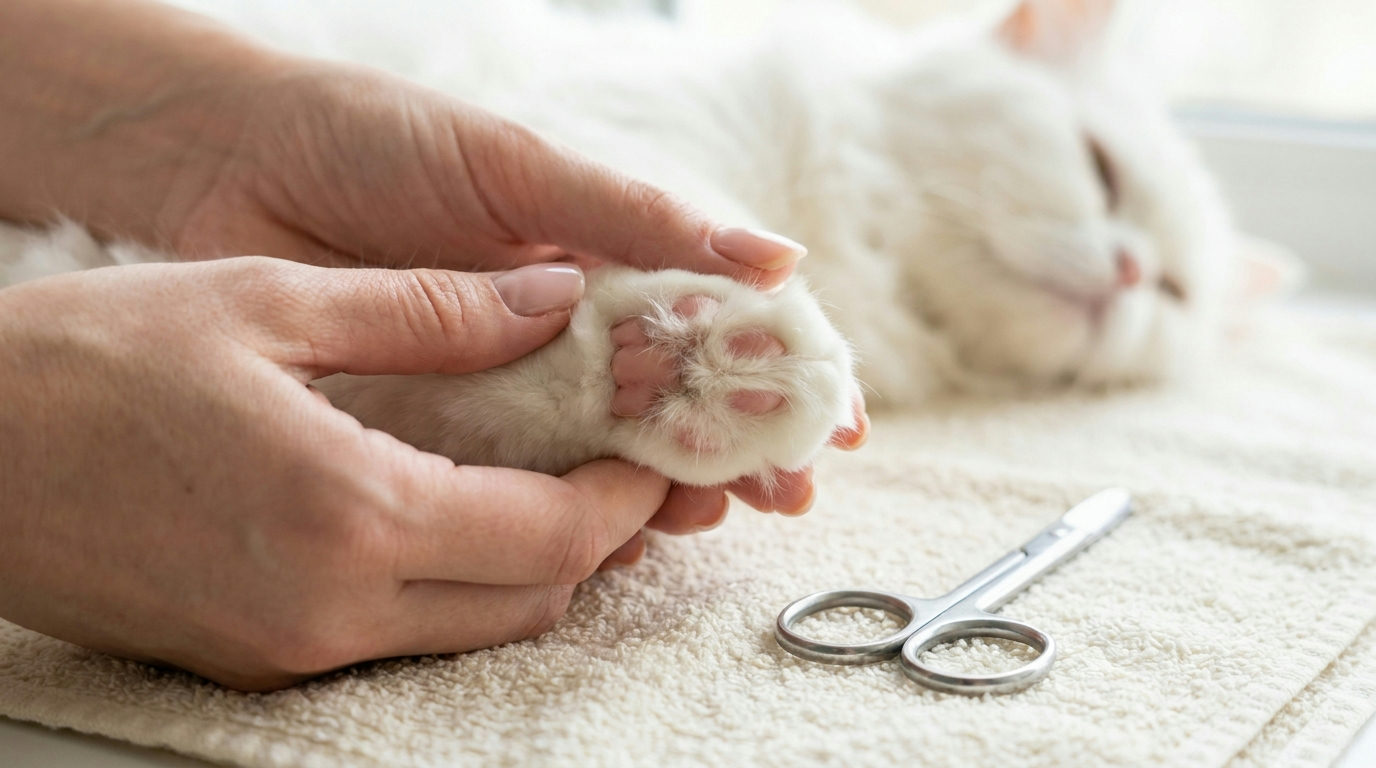
Look underneath your Persian’s feet and you may find more fur than paw. Long tufts grow between the toes and around the pads, and while they look sweet, they can collect litter, trap dirt, knot up and even make it harder for your cat to grip smooth floors. Learning to trim paw fur on a Persian cat is a small, useful skill that takes only a few minutes a month.
This guide covers why paw fur matters, what you need, a safe step-by-step method, how to get a reluctant cat used to paw handling, and when to leave it to a professional.
Not veterinary advice: This content is not a substitute for professional veterinary advice, diagnosis or treatment. Always consult your veterinarian about your own cat.
Why Persian paw fur needs attention
Persians are bred for a full, heavy coat, and that includes the feet. Many have noticeable tufts between the toes. For a show cat, those tufts may be part of the look. For a cat living in a home, they can cause a few everyday problems:
- Litter tracking. Clumping litter sticks in long paw fur and gets carried across the house.
- Mats between the toes. Fur that stays damp or dirty can knot tightly around the pads, which can be uncomfortable to walk on.
- Slipping. Fur covering the pads can reduce grip on hard floors, which matters more for older or less steady cats.
- Hygiene. Paw fur can hold on to faeces, food or anything else your cat steps in.
Cats.com’s guide to grooming long-haired cats lists trimming fur around the paws, along with ears and sanitary areas, as part of regular long-coat care.
What you’ll need
- Small blunt-tipped scissors with rounded ends. Pointed scissors are too risky near toes and pads.
- Or a small, quiet pet trimmer made for paws. Many cats accept the gentle hum of a small trimmer better than a full-size clipper.
- A fine-toothed comb to lift the fur between the toes.
- A towel to wrap your cat if needed, and a helper for the first few times.
- Treats your cat loves.
- Good light. You need to see the pads and the skin between them clearly.
Some pages on this site contain affiliate links; this article does not.
Step-by-step: how to trim paw fur on a Persian cat
Choose a time when your cat is calm and relaxed, such as after a meal or during a lazy afternoon nap. Do one or two paws per session if that is all your cat will tolerate. There is no rule that says all four have to be done at once.
- Get comfortable. Sit with your cat on your lap or beside you on a towel. Stroke the head and body first.
- Hold the paw gently. Cup the paw in your hand. Press very lightly on the top of the foot so the toes spread slightly.
- Comb the fur. Use the fine comb to lift the fur between the toes and around the pads. If you feel a tight knot, do not pull it. Work it loose with your fingers, or leave it for a groomer.
- Trim the fur level with the pads. With blunt scissors, snip the fur that sticks out beyond the pads, keeping the blades flat and parallel to the pad surface. Do not dig down between the toes. The goal is to tidy the fur, not to remove it to the skin.
- Tidy the outline. Turn the paw over and trim any long, straggly fur around the edge of the foot to give a neat, rounded shape.
- Reward. Give a treat after each paw, or after each few snips at first.
- Check the claws. While you are there, check whether the claws need trimming. Our Persian nail trimming guide explains how.
If you use a trimmer instead of scissors, glide it gently over the underside of the paw, keeping it flat against the pads. Let the trimmer do the work and avoid pressing into the skin between the toes.
Safety tips
The skin between a cat’s toes is thin and delicate. A few precautions keep trims safe:
- Never point the scissor tips towards the skin.
- Keep your fingers between the blades and the skin where you can.
- Trim a little at a time. You can always take more off next week.
- Stop if your cat starts pulling hard or twisting. A sudden jerk is when accidents happen.
- If you nick the skin, apply gentle pressure with clean gauze. Contact your vet if it does not stop bleeding quickly or looks deep.
Getting your cat used to paw handling
Many cats dislike having their feet touched, and Persians are no exception. It helps to practise paw handling on days when you are not trimming at all. International Cat Care has produced a set of handling videos for owners, including one on helping your cat accept having its paws checked and claws clipped.
A simple training approach looks like this:
- Days 1 to 3: Touch a paw briefly while stroking, then give a treat.
- Days 4 to 7: Hold the paw for a few seconds, then treat.
- Week 2: Gently press to spread the toes, then treat.
- Week 3: Touch the paw with the closed scissors or the switched-off trimmer, then treat.
- Week 4: Trim a few hairs on one paw, then treat and stop.
Go at your cat’s pace. If they pull away, go back a step. Our guide to building trust before grooming has more on this.
How often to trim
Most Persians need a paw tidy every four to six weeks, but it varies with how fast the fur grows and what litter you use. Check the paws weekly during your normal grooming routine. When fur starts to stick out beyond the pads or you notice more litter being tracked, it is time.
When to see a groomer or vet
Hand the job over if:
- There are tight mats between the toes that you cannot loosen with your fingers.
- Your cat struggles hard, bites or seems very distressed every time.
- You see redness, swelling, cuts, discharge or a bad smell from the paw.
- Your cat is limping, licking one paw a lot, or reluctant to walk.
Paw problems such as injuries, infections or overgrown claws can look similar to a simple mat at first. If a paw seems sore, have your vet check it before you trim.
Paw fur trimming checklist
- Good light, blunt scissors or a small trimmer, a comb and treats.
- Comb first, and never cut a mat you cannot see under.
- Trim level with the pads, not down between the toes.
- Keep blades flat and pointed away from the skin.
- One paw at a time is fine.
- Repeat every four to six weeks, checking weekly.
Once you and your cat get used to it, you can trim paw fur on a Persian cat in just a few minutes. Your floors will stay cleaner, your cat will grip better, and you will spot any paw problems early.
Not veterinary advice: this article is general guidance and is not a substitute for professional veterinary advice. Consult your veterinarian about your own cat.

