
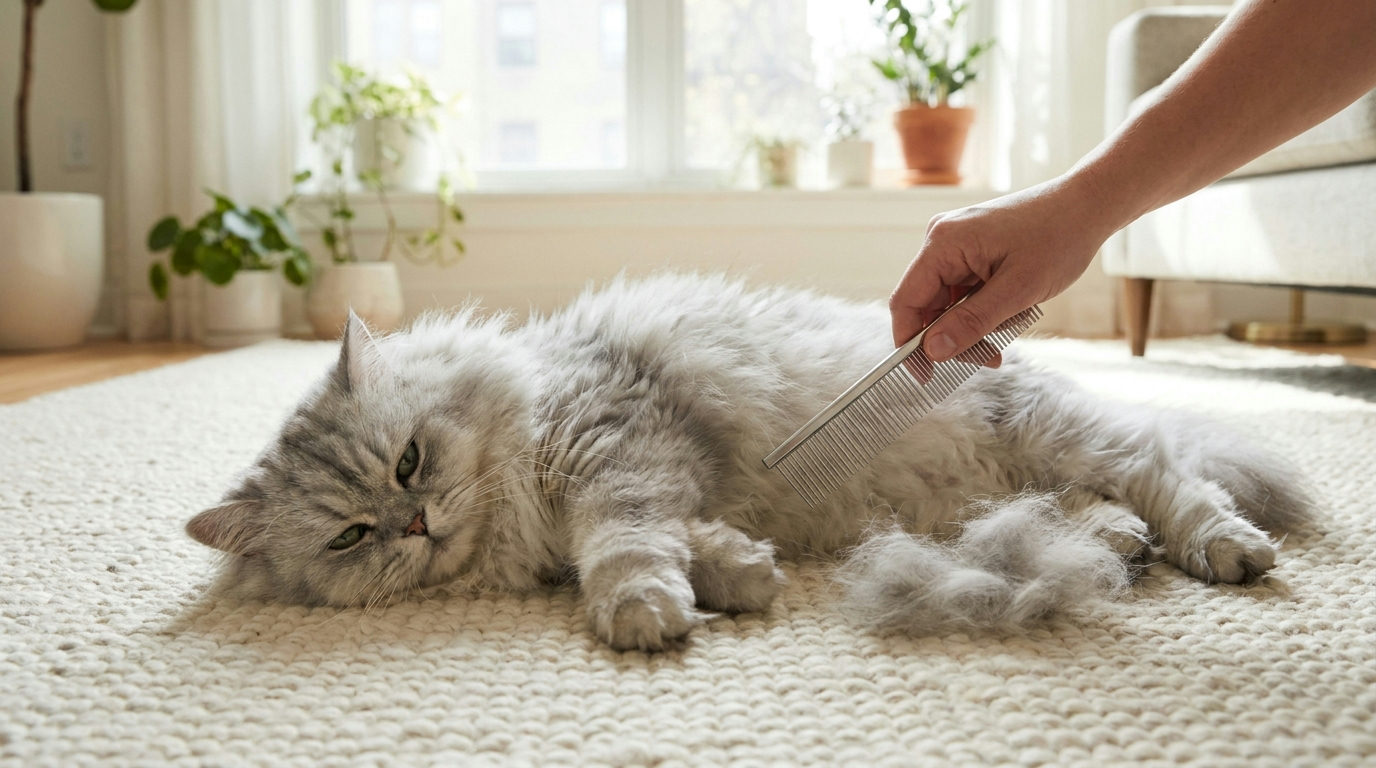
That hacking, retching sound from the next room is familiar to most Persian owners. Hairballs come with a long, dense coat. But “common” is not the same as “nothing to worry about”, and the amount of hair your Persian swallows is something you can influence every day.
This guide explains why Persian cat hairballs happen, how grooming helps, what else may reduce them, and the signs that mean you should call your vet rather than wait.
Not veterinary advice: This content is not a substitute for professional veterinary advice, diagnosis or treatment. Always consult your veterinarian about your own cat.
Why Persian cat hairballs happen
Cats groom with a rough tongue covered in tiny backward-facing hooks. Those hooks catch loose hair, and the cat swallows it. Hair cannot be digested. Most of it passes through the gut and comes out in the litter box, but some can clump together in the stomach.
The MSD Veterinary Manual describes how swallowed hair sticks together in the stomach to form a hairball, which the cat often vomits up. It also notes that a hairball can sometimes stay in the stomach, harden, irritate the stomach lining or even block the digestive tract, and that longhaired breeds are at greater risk.
A Persian’s coat is long, fine and thick, with a dense undercoat that sheds heavily, especially in spring and autumn. More loose hair in the coat means more hair on the tongue, and more hair in the stomach.
Are hairballs ever “normal”?
Many owners and even some vets treat an occasional hairball as just part of living with a cat. It is not quite that simple. A review in the Journal of Feline Medicine and Surgery points out that it is unclear whether frequent hairballs are ever truly normal, and that in shorthaired cats they are often a sign of an underlying problem, such as itchy skin disease, fleas or a food intolerance, that makes a cat groom more or slows the gut down.
Longhaired cats like Persians have more hair to deal with, so an occasional hairball is less surprising. But a change in frequency, or hairballs alongside other symptoms, is worth raising with your vet. Hairballs can also be confused with other things: a cat that is coughing rather than retching may have a breathing problem, not a hairball.
How grooming reduces hairballs
The simplest way to cut down on swallowed hair is to remove it before your cat does. International Cat Care’s grooming advice notes that helping to remove loose hair from the coat can prevent it being swallowed and later vomited as fur balls. For a Persian, that means regular combing that actually reaches the undercoat.
Comb to the skin, not just the surface
Brushing the top layer looks nice but leaves the loose undercoat behind. Use a wide-toothed metal comb first, working in small sections down to the skin, then follow with a finer comb. If the comb comes away with a soft, fluffy cloud of fur, that is exactly the hair your cat would otherwise swallow.
Groom more during shedding seasons
Persians often shed more heavily as the seasons change. During those weeks, increase from a daily quick comb to a slightly longer session, or two short ones. Our guide to seasonal shedding has more on managing those periods.
Keep mats from forming
Mats trap loose hair and make cats groom awkwardly at the same spot. Check the armpits, behind the ears, the belly and the back legs every day. A small tangle combed out today is much easier than a mat next week.
Wipe the coat after combing
A slightly damp cloth or grooming glove run over the coat after combing picks up stray loose hairs you missed. It takes seconds and most cats find it pleasant.
Other things that may help
Grooming does most of the work, but a few other steps may support it. Always check with your vet first, especially if your cat has any health conditions.
- Hairball-control diets. Some commercial diets and treats are formulated to help hair pass through the gut. The MSD Veterinary Manual mentions these as one option.
- Hairball remedies. Lubricant products are available, but ask your vet before using them. Do not give mineral oil or other home remedies without veterinary advice.
- Water intake. A well-hydrated cat may pass things through the gut more easily. Fresh water in several spots, or a fountain, may encourage drinking.
- Play and enrichment. Some cats over-groom when bored or stressed. Short daily play sessions give them something else to do.
- Flea control. Itchy cats groom more. Keep up with flea prevention your vet recommends. See our guide to checking a Persian for fleas.
Some pages on this site contain affiliate links; this article does not.
When a hairball is an emergency
Most hairballs come up and your cat carries on as normal. But a hairball can occasionally cause a blockage, and some symptoms that look like hairballs are something else. Call your vet promptly if your cat:
- Retches or gags repeatedly without bringing anything up
- Vomits several times in a day, or vomits food as well as hair
- Stops eating or seems uninterested in food
- Is lethargic, hiding or seems in pain
- Has a swollen or tender belly
- Is constipated or has not passed stool for more than a day or two
- Has diarrhoea, or blood in vomit or stool
- Is coughing, wheezing or breathing with effort
A cat that keeps trying to vomit and cannot is a same-day vet call. Do not wait to see if it passes.
Common questions
How many hairballs are too many?
There is no single number that applies to every cat. What matters most is change. If your Persian used to bring up a hairball occasionally and is now doing it every week, or seems unwell with it, talk to your vet.
Does a lion cut stop hairballs?
A shorter coat means less hair to swallow, so some owners find it helps. But a clip has its own downsides. Regular combing is usually the first thing to try. Our article on the lion cut for Persian cats covers the pros and cons.
Can kittens get hairballs?
Yes, though they are less common in young kittens. Starting gentle combing early helps a kitten get used to grooming, which makes life easier as the adult coat comes in.
A simple anti-hairball routine
- Comb to the skin once a day for five to ten minutes.
- Increase combing during seasonal shedding.
- Check for mats daily in the armpits, belly and back legs.
- Keep fresh water easy to reach.
- Ask your vet about diet or remedies before trying them.
- Keep a rough note of how often hairballs happen, so you notice changes.
You cannot stop a Persian grooming, and you would not want to. But every bit of loose hair you comb out is hair that does not end up in your cat’s stomach. Regular grooming is the most useful thing you can do about Persian cat hairballs, and it doubles as a daily chance to check your cat’s skin, weight and general condition.
Not veterinary advice: this article is general guidance and is not a substitute for professional veterinary advice. Consult your veterinarian about your own cat.

